
Attack surface
Your exposed services, with their context.
Connect exposed applications, domains and external services to available information about your business. Examine the evidence before setting priorities.
Swipe across the visual to read the details.
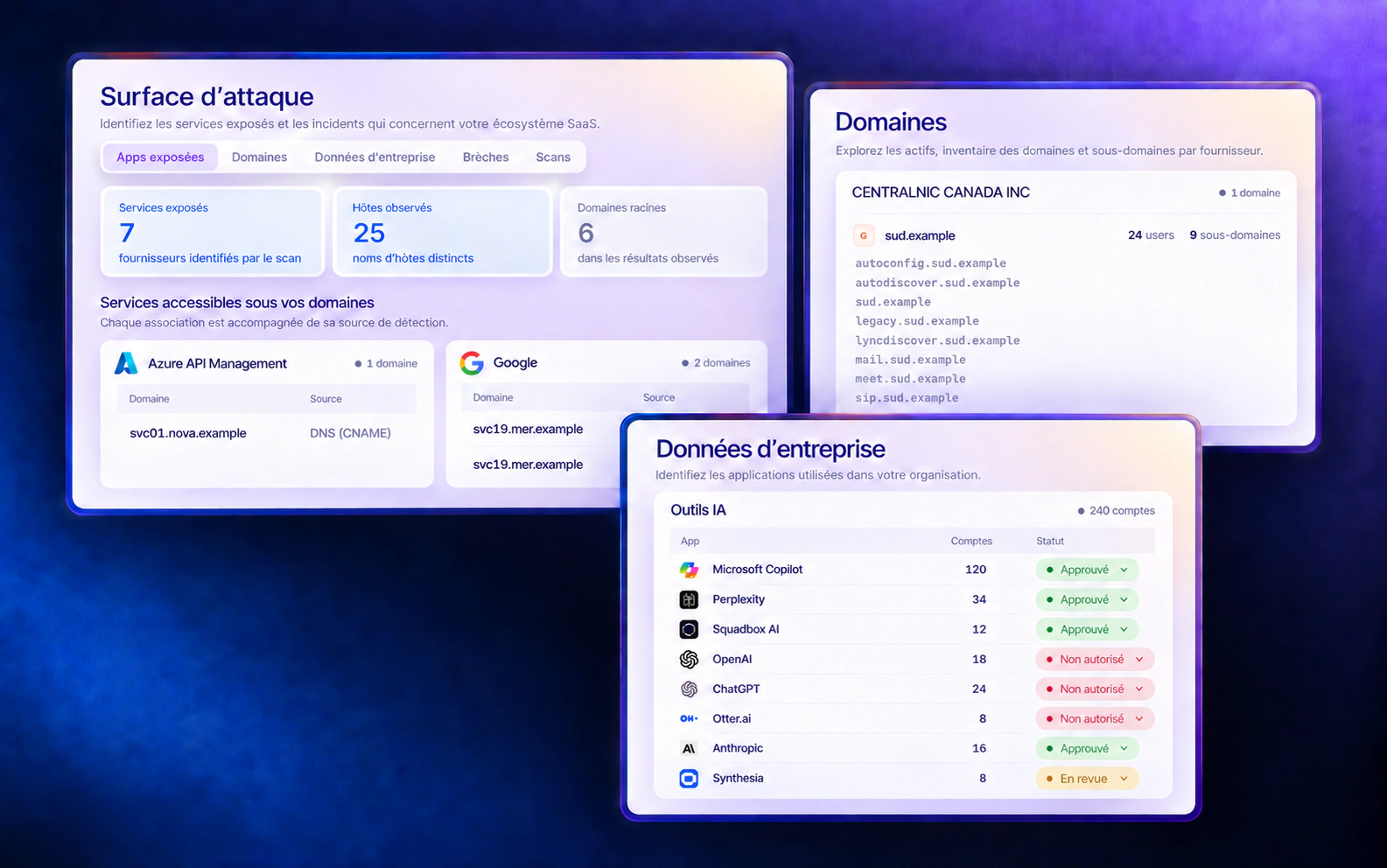
Connect the observations. Keep their evidence.
A domain name or vendor on its own is not enough. The source and connection to your environment give meaning to the observation.
- Exposed applications
- Find accessible services associated with observed domains. A service visible on the Internet is not, by itself, a vulnerability.
- Domains and external services
- Browse domains, subdomains and associated vendors. A DNS observation, such as a CNAME, provides a clue to verify in context.
- Company information
- Connect discovered applications and accounts to available information. A discovered account does not prove that a recent sign-in was observed.
From an observed service to the right priority.
Start with items connected to your business and the data your team wants to protect.
Confirm the connection
Check the domain, source and observation date. Confirm who manages the service before assigning an owner.
Examine the context
Review available vendor information and associated access. An incident at a vendor does not demonstrate that your business is affected.
Prepare an action
Prioritize checks with your team, then prepare appropriate interventions and track their status.
Scope matters
An observed view, with its limits.
Coverage depends on the domains examined, sources, scans and their dates. It is not an exhaustive inventory of all assets or a complete test of their security.
A detected association or an absence of results still needs interpretation. Available evidence guides verification; it does not replace confirmation by the service owner.